
Note to Readers
Brian McLaren
April 2006
I sometimes feel that I am the most fortunate person in the world. I have the privilege, first of writing books, and then of getting to travel and meet so many of my readers in person. In addition, so many readers take the time and effort to write or email me with kind and encouraging words. Thank you so much. Even though I can’t respond to all the email and letters I receive, I am sincerely grateful for your encouragement.
Your encouragement is especially meaningful in light of the increasing levels of criticism I have received over the last year, much of it unfair and inaccurate, much of it, no doubt, richly deserved. It is in regard to criticism that I would like to make several requests of my supportive readers. When people become contentious, we have a special responsibility to be peacemakers. If you consider these requests, you will be helping me and I will be deeply and personally grateful.
1. Please do not cause dissension, division, or trouble on my account (or any other account!). If others say or write unfair or inaccurate things about me or my writings, please do not respond in kind. You may wish to offer some words of personal testimony by telling people how God has in some way helped you through my work, or you may want to offer your personal observation if you have met me in person, but please, please do not respond with harshness, counterattack, or defensiveness. If you read a harsh or unfair review, instead of getting upset with the content or tone of the review, simply set a better example by writing a constructive review. If someone writes something that insults you, let them know how you feel – not in an accusatory way, but in a vulnerable way: “I felt insulted and misunderstood when I read your blog post.” Paul said, “Don’t let what is for you a good thing be spoken of as evil,” and he also said that in matters of dispute, we should keep our opinions to ourselves (Romans 14). These provide parameters, I think, for knowing how to respond. In all cases, please remember the Proverb that says, “A soft answer turns away wrath, but grievous words stir up anger.”
2. Please do not make me or even my books the issue. Make Christ and his teachings the issue, and make a right understanding of the Scriptures the issue. If you want to bring up an idea that you read in my book, instead of saying, “McLaren says,” or “The Secret Message of Jesus” says, or whatever, point to Jesus’ own words, or other relevant words from Scripture. I haven’t seen many examples of “dueling Bible verses” producing good results, especially on blog sites, but sometimes a non-combative and gentle appeal to a Scripture can help some people see things in a new light.
3. If you have become convinced of something from one of my books, and you hear a preacher or friend say the opposite, if at all possible, just let it slide. Instead, try to hear what they’re saying in a charitable light and learn whatever you can from it. Affirm whatever you can and don’t argue about the rest. The proverb says it’s a person’s glory to overlook an offense, and Paul calls us to be longsuffering and patient, often reminding us not to be quarrelsome or contentious in any way, but to be kind to all, patient when wronged, and gentle with everyone.
4. Please don’t recommend my books to people who aren’t ready for them. I wouldn’t have been able to handle some ideas in my books twenty years ago, so I am sympathetic to people who can’t handle them now. The book that means the most to you may be a distraction to one of your friends, so please be careful and prayerful in this regard. Timing is, as they say, everything. If Paul’s inspired writings were considered by Peter to be hard to understand easy to distort, then no doubt my scribbles and ramblings will be confusing and problematic for some people. I’d recommend my new book, The Secret Message of Jesus, along with More Ready Than You Realize and Finding Faith, as the most accessible of my books, but even they would be unprofitable for some people. All Scripture is profitable, but not everything else is universally profitable!
5. If you have become convinced of some things from my books which put you at odds with your church or organization, please do not undermine the leadership there. Please! People often ask my advice in these situations. I don’t think there is a universal prescription (except love your neighbors!), but when I was a senior pastor, here’s what I wish people would have done if they had differences with my leadership or teaching: First, I wish they would have come to me (or written to me) in private and in a friendly and nonthreatening way told me what they have come to see or believe (not what they think I should see or believe!). Then I wish they would have asked me for my advice on what they should do. Would I like the opportunity to present them with counter-arguments? Would I prefer that they leave and find another church? Would I prefer that they stay and share their ideas, gently and patiently of course, with others? Would I prefer that they form a small group to dialogue about these matters? Or maybe I think that they’re on the right track, but this congregation isn’t ready for their ideas, so perhaps they should consider finding or forming a new faith community? Third, I would have appreciated a promise that they wouldn’t cause dissension in the congregation, but would instead pursue what makes for peace and mutual edification.
If it turns out that you should leave, please write a letter of thanks to the church leaders – without even a hint of criticism – and leave them with a blessing, so that whenever you see one another in the future, they’ll have a good feeling about you and gratitude for your mature spirit. I think it is a good gesture to give a generous financial gift as part of your goodbye. If you have duties at the church, don’t leave without finding and training a replacement. Above all, don’t even get close to a church split or anything like it. It’s better to quietly withdraw than disturb the peace of a faith community in any way. Again echoing the apostle Paul, as far as it depends on you, be at peace with everyone, and be diligent to preserve the unity of the Spirit in the bond of peace.
6. If you are a pastor or other leader yourself, please do not impose on your congregation or organization ideas you have become convinced of through my books. Change is a process that requires wise and patient leadership. To rush new ideas into a sermon is often the very worst way to bring about change – apart from a change of address and employment, that is! If your congregation is open to new ideas and seeks a transformation in its identity to a more missional and emergent vocation, I would highly recommend you begin by finding an experienced consultant that you trust to guide you in this process. (I can highly recommend my colleagues at ILSCC.net, and there are many other good consultants whom I personally know and respect.)
7. If you are mistreated simply because you agree with ideas in my books, then by all means seek out some friends who will understand. You’ll need some people with whom you can be open and honest so that you can process the pain and grief of mistreatment. You may need to seek a professional counselor or spiritual director’s help. Whatever you do, don’t let the mistreatment of others destroy your faith or make you lose heart. Doing so will in the end empower the people who have behaved badly. Instead, let their mistreatment drive you deeper into God’s compassionate care. Elsewhere on this site, you will find a prayer that has helped me so much when I experience mistreatment. I can’t tell you how much it has meant to me. For several months, I prayed this prayer day after day, and parts of it I now know by heart. It has helped me to see people who have hurt me not as enemies but as “cruel friends” for whom I can sincerely thank God.
8. An idea: if you’re excited about something you’ve gained from my work, instead of turning it into discussion, first turn it into action and invite others to get involved with the action. For example, get some people together to do something for people in need in your community, or clean up a stream or park, or organize around a justice issue you care about, or address some down-to-earth problem for your church (paint a classroom or remodel a bathroom or build a playground), throw some big parties for friends who aren’t connected to God. In the end, action is what counts, not words. If people use my books to stir up arguments, it’s a guarantee they haven’t understood what I’m writing about; if they get involved in compassionate action, it’s a good sign they get it.
9. If you see people who have been helped by my books doing the opposite of one of these requests, please encourage them to read or re-read this letter. It might even be good, if you have a study group who reads one of my books, to go over these requests at the beginning or end of your study. And if you have done the opposite of one of these requests, by all means, humbly and sincerely apologize to those you hurt or offended.
It has been my policy to avoid defending myself. Occasionally I have offered some clarification, and I am in the process of writing a friendly note to my critics, asking for their cooperation in raising the quality of dialogue in our Christian communities. But I do not want to become defensive, nor do I want to get anywhere close to counter-attack, aggressively or passive-aggressively. If I do that, I have violated the message I’m trying to live and communicate.
On a positive note, the amount of criticism I receive regarding my books is small compared to the warm and moving accounts I hear of people being blessed by God through them. The criticism has been less severe than I feared, and the positive response has been far more wonderful than I had hoped. Over time, perhaps those positive effects will become more visible and will soften the hearts of the critics to some degree.
Again, I thank you for reading my books and considering these requests. And I thank God for the privilege of in some way serving you, even indirectly, through writing. May God’s kingdom come, and may God’s will be done on earth as it is in heaven through all we do.

0 Comments15 Minutes
A Friendly Note to My Critics
By Brian McLaren
Summer 2006
You would think after 24 years of serving as a pastor I would get used to it. You would think I would get a thick skin so that criticism wouldn’t bother me. But I confess that I am disheartened by some forms of criticism. Obviously, I am aware of the fact that some of my ideas are controversial. I believe that all controversial ideas need plenty of scrutiny – as do many non-controversial ones. I do not in any way think I am above scrutiny, and I have been wrong enough times in my life to be sure that I will need ongoing correction for the rest of my life.
I struggle more whenever a new book comes out. Books are like kids, and the release of a new book is like sending your child off to school for the first time. You don’t want her to get made fun of for her thick glasses and braces. You know she’s a little clumsy and overweight, but you don’t want her to be chosen last for the team or called mean names. You don’t want her to get pushed around on the playground by the local bullies. You see her potential, and you hope that others will, and it hurts when they judge her by her looks, or when they make her the focus of their faultfinding mission. Of course she’s not perfect, but you know she has value and you hate to see her treated badly.
Thankfully, some criticism comes in a truly constructive way – it helps me, informs me, and helps me be a better person, writer, and Christian. In my most recent book, for example, The Secret Message of Jesus, a few readers pointed out a few small factual errors in the text. Thankfully, those mistakes were not substantial, and they will be corrected in future editions.
So it’s not the helpful pointing out of factual errors that disheartens me; it’s the unfair, inaccurate, unreflective, and mean-spirited responses – especially when they are done in the name of God. I imagine that some fair-minded people who deeply disagree with my books also wince at the way less fair-minded people critique me or my work.
When people who claim to love the Bible launch unfair, inaccurate, unreflective, and mean-spirited attacks, especially when they do so on a public and international forum like the internet, they are not only hurting me and sometimes my readers (which they may not care about) – they may also be hurting the cause of Christ (which they do care about). After all, the Bible clearly says we must not bear false witness, spread rumors, or indulge in uncharitable or unwholesome speech. It says we should do to others as they do to us and act justly. It asserts that our love for one another reflects on the credibility of our message. It tells us we should examine ourselves and look at obstructions our own eyes (which would include flaws in our own viewpoint or perspective) before we try to perform eye surgery on someone else. This kind of behavior among people who claim to love the Bible, Jesus, Christianity, orthodoxy, and truth brings dishonor on these very things.
So, in a fraternal and hopeful spirit, I would like to make several requests of my critics.
1. Accuracy: I repeatedly read people claiming, “McLaren says…” or “McLaren believes…” when I have either never said what they claim or explicitly denied it. Or they make exaggerated statements like, “McLaren doesn’t believe anything,” or “He questions everything.” Even though you think I’m wrong, may I ask you to accurately represent me, and not push what I say to an absurd extreme that any sane person would reject?
2. Fairness: Sometimes people accurately quote one sentence, or part of one sentence that I have written, and then use it to claim I am being imbalanced or dualistic or reductionistic, and so on. I often go back and check the sentences or phrases they quote, and then I notice that in the very next sentence or paragraph, I qualify or balance or add nuance to what they have quoted. If you are on a fault-finding mission, you will quote the first sentence and ignore the second, but if you are pursuing fairness – as an expression of your own integrity and good character, can I ask you to seek to be more fair?
As well, may I politely ask you in the interest of fairness to avoid guilt-by-association? This works two ways. First, I read and quote a wide variety of people. More than that, I try to build friendships with people with whom I disagree. With increasing frequency, I find that people are attacking me because I keep company with certain people (and even speak with them) or I quote someone who we would both agree is wrong on many counts. Since Jesus was a friend of sinners, and since Paul quoted “pagan” poets on more than one occasion, can I ask you to refrain from using guilt by association in your critique? Second, I find critics attacking other people merely for keeping company with me or listening to me. Be assured, people often are kind enough to speak with me or quote me on occasion even though they disagree with me on other points. I hope you won’t criticize them for doing so. Perhaps they’ll have a good influence on me!
3. Judgmentalism: There is a difference between truthfully reporting a statement and uncharitably inferring a motive. So when people say, “McLaren shows contempt for the Bible,” or “McLaren is a coward because he didn’t answer my question directly,” or “McLaren thinks he is better than everyone else,” that seems less like an act of reporting or analysis and more like violating Jesus’ command not to judge. In Paul’s famous love passage, he says that “love believes all things,” which seems to mean that love believes the best – it tries to interpret other people’s behavior not cynically, but charitably, graciously giving the benefit of the doubt. Similarly, Jesus sums up the law and prophets by teaching us to treat others as we would be treated. Unless you would like others to jump to conclusions about your motives and assume the worst about you, may I ask you to fairly and accurately engage with my ideas, but try to avoid making judgments about things you simply do not know – my heart, my motives, my intentions?
4. Rumors: It is quite distressing to see inaccurate or unfair or judgmental things said about my writings or my own character. But it is even worse when these rumors are passed around as facts. Recently, I’ve read a number of reviews by people who admit they have never read my books, but are working from hearsay. Please don’t spread rumors, and please don’t believe unsubstantiated claims.
5. Lack of Self-examination: Those who attack my ideas often do so in a way that shows they haven’t really examined themselves. For example, someone recently criticized some of my writings in ways opposite to what I’m requesting here. Then he quoted a Bible verse to refute what he claimed to be my position. (Sadly, he had misinterpreted my actual position, so he was attacking a straw man.) Interestingly, the Bible verse he referred to actually contradicts the position he claimed to hold. Even if I am wrong in my view, this kind of unreflective reaction is a bad reflection on the Christian faith. So please, if you use a Bible verse to try to refute me, first see if it actually supports your own position.
6. Name-calling. Words and phrases like “liberal,” “heretic,” “of the devil,” “Satanic,” “fundamentalist,” and so on are very effective in discrediting someone, but they are also rather childish and unhelpful and divisive. Those of us who are parents don’t like our children calling each other names in this way, and I am quite certain God has similar feelings when we resort to name-calling.
7. Harshness: In 2 Timothy 2, Paul advises his younger associate to use gentleness when he seeks to correct people in error. I’ve noticed that whenever I am harsh with people, I am less likely to gain a hearing for my message. In fact, some of your frustration with me may come exactly from times when I have been harsh, which I sincerely regret. If you are hoping to correct me or people who feel they have been helped my books, may I ask that you do so with gentleness? That way, if you’re completely right in your correction, you’ll increase the chances that we’ll listen. You’ll allow us to respond to the truth of your corrections rather than drive us away with the spirit in which you express them. And if you are not completely right, you will have made it easy for there to be constructive dialogue so that we can all grow through our interchange – instead of filling the body of Christ with the toxins of attack, defense, counterattack, and so on.
8. Disharmony: I’ve noticed that intelligent people often use a “but” when they could more profitably use an “and.” For example, I might make a statement that is true and accurate and needed as far as it goes. But obviously, that one statement still doesn’t say everything that needs to be said. So, someone else can wisely and helpfully add the word “and,” and build on what I’ve said, contributing balance, depth, nuance, and so on. This is how good conversation progresses. But if she instead implies I am stupid or wrong or dishonest for not saying both what I said and what she wishes to add, that strikes me as unhelpful. She has a chance to work in teamwork with me for the common good, but instead she chooses to set us up as enemies. I love Paul’s words in this regard in 1 Thessalonians 5: “Therefore, let us pursue what makes for peace and mutual upbuilding,” or his words in Ephesians 4: “Be diligent to preserve the unity of the Spirit in the bond of peace.”
In that light, I want to say again that wherever I have been harsh in any of my writings, whenever I have come across to you as divisive and disrespectful, I am truly sorry. These eight requests are communication practices to which I aspire, but sadly, I fail to practice them at times. So of course I will endeavor to be gracious to those who fail to meet these ideals, since I stand in need of grace myself. I have made it my policy to avoid name-calling or even naming individuals in a negative light. I have tried to present my ideas with humility so that others do not feel shamed or insulted in any way. But I am sure that I have failed on more occasions than I realize. I have many regrets in my life, many of which relate to the way of I have critiqued others. Looking back, I have never been proud of even one time when I have been harsh, sarcastic, or disrespectful in my words or attitudes to other human beings.
So I want to assure you, if you find yourself among those who deeply disagree with me, that I mean you no harm. I repeatedly tell people, if they are happy and confident in your approach, that they stay with it and ignore me, my work, and my friends entirely. I am not here to steal any of your “market share” or do you harm in any way. Instead, I’m here for all the people who can’t survive following your way of thinking and your way of doing things. These people, many of them, are about to leave the church and the Christian faith entirely. Many have already left in disillusionment. Many are seekers with lots of issues, the kinds of people for whom your churches aren’t ready, nor are they ready for you. You may consider them apostates or pagans or whatever, but these are the people I feel some calling to help – so they can be connected to Christ and his mission even though they can’t function in the religious settings over which you preside or in which you are yourselves sincerely satisfied and blessed. I am not your enemy. I see myself as your colleague, just as Paul, who consented to work with Gentiles at the margins, was the colleague of the apostles in Jerusalem, who continued to focus on serving the Jewish community.
Paul wisely said in Galatians 5 that we must be careful. If we bite and devour one another, we will consume one another. Jesus similarly said that a kingdom divided against itself cannot stand. Yes, there is a place for mature and direct debate, but a person’s attempt to correct another’s errors can in some cases create more trouble than the original person’s errors. I hope we who disagree on some matters can agree to work together to avoid that sort of vicious cycle.
Whenever I am shown to be wrong, I pray that my love for God and God’s truth will lead me to side joyfully with my critics against my own writings. But until I am convinced that I am wrong, all I can do is seek to tell the truth as I see it, and raise questions that I believe must be raised, with appropriate humility and openness to correction, while pleading with those who disagree to do so in ways that will not harm the communities and values we all cherish.
Whether or not you agree with these requests, be assured that I am committed to prayerful self-examination in light of all critique, and I seek to learn from all attempts to help or instruct me, even if those attempts come out in a less-than-ideal way. When critiques are obviously unfair or intentionally malicious, I hope I can receive them as opportunities to grow in my Christian character and follow the example of Christ, whose gracious response to mistreatment is one of the ways he fully and perfectly revealed the gracious character of God.
So in summary, I hope that if you are among my good Christian critics, you will aspire to be a good Christian in the way you respond to my writings, even if you think I am a bad Christian for what I write or the questions I raise. We have a chance to model constructive dialogue rather than the religious bickering which has too often characterized all our religious communities. Even if I am as wrong you think I am, what good would it be to prove a wrong person wrong if in the process right people prove themselves mean-spirited, unfair, unreflective, inaccurate, dishonest, or hypocritical?
One final request. I hope that none of us will spend so much time in internal debate about our beliefs that we neglect putting our beliefs into action. It would be tragic for both you and me if our differences distracted us and others from what religion is supposed to be about: helping widows and orphans and others in need, and keeping ourselves “unspotted from the world,” as James says.
There is much more that could be said, but I fear this is already far too long. Please feel free to link to this note or pass it on to people for whom you believe it would be helpful.
0 Comments21 Minutes
Fall/Winter 2006 Update
Greetings, friends!
Thanks for your interest in my work. I hope that you have found some encouragement and help in my books, and I hope this website will also be of value to you.
I had an unforgettable summer - I spent 5 weeks travelling Latin America, teaching and dialoguing in seven countries, from Mexico to Chile and Argentina. For most of the trip, I travelled with Dr. Rene Padilla, a theologian and leader from whom I have learned so much. I met so many wonderful people - you can read a rather lengthy report here. (Also see Orientacion Cristiana.)
I've been in 20 different countries this year, and everywhere I've gone, I've heard leaders lamenting the fact that the church in the USA doesn't seem to listen to their sisters and brothers in the rest of the world. I invited a number of friends to send me short messages that they'd like the Christian community in the US to hear, and I'll be posting their messages here soon.
You'll also find some big news about my plans for 2008. You might want to be involved!
This fall, I'll be in Kansas, Minnesota, Indiana, New Brunswick, North Carolina, New York, Pennsylvania, Missouri, Washington State, Tennessee, California, Virginia, Florida, Arkansas, and Illinois ... maybe we'll get to meet in person in one of these places. (See the schedule for details.) It's clear that I won't be bored!
Meanwhile, I'll be finishing up "Jesus and the Suicide Machine" between now and the end of the yar. I finished the first draft while in Argentina ... I'm so excited about this book. Be prepared for something quite different from anything I've written before.
I've been getting some wonderful reports of people using "The Secret Message of Jesus" for sermon series, small groups, classes, and even retreats. Just as I'd hoped, the book connects with people who are "spiritual but not religious," skeptics, and otherwise unconnected from Christian commitment - along with committed Christians too. The book has had a stronger start than any of my previous books.
Other news - I begin my term as board chair for Sojourners (sojo.net) this fall. I've also been working closely with Jim Wallis, Tony Campolo, Adam Taylor, Diana Butler Bass, Amy Sullivan, and others in a new venture called "Red-Letter Christians." Many of us have been trying to find ways to stop the genocide in Darfur, Sudan. I hope you'll do what you can to help as well.
And as always, I'm thrilled to see what's happening with emergentvillage.com. Good things are happening!
I thank God for the privilege of serving you in some small way. Thanks for your encouragement and interest. Let's keep on ... plotting goodness!
Brian
0 Comments3 Minutes
Favorite Books from 2005
Some Great Reads from 2005
I can't believe how many tremendous books are being published. Add to
them the great books from the past that I've only recently discovered,
and sometimes I hope I can live to be 125 just so I won't miss too
much. But even then, I would still miss so much, because there are
more excellent books waiting for us than one person could ever digest.
So - here are ten top recommendations from my little corner of the world.
First, I read several books on faith and social justice this year.
Among them, four stood out.
1. Jim Wallis, God's Politics.
2. Jimmy Carter, Our Endangered Values
3. Rabbi Michael Lerner, The Left Hand of God (to be released in 06)
All three of these books seek to begin a dialogue after many years of
monologue by the Religious Right. I found each of them alarming and
inspiring at the same time.
4. C. K. Prahalad, The Fortune at the Bottom of the Pyramid. While
this book is not religious, it makes one point very well - and I think
it maps out a plan for helping the poor that could bring together
caring Christians from the left and right.
I always try to keep some good fiction and poetry on my reading list.
Of special pleasure this year were two books:
5. Wendell Berry, The Memory of Old Jack. Tender, humane, insightful,
heart-breaking, and beautiful ... I feel like a better human being
after I read Berry's work.
6. Garrison Keillor, ed., Good Poems. Put this one beside your bed
and read a few each night. You'll feel afresh what an amazing thing
language is.
Three works of theology were most stimulating to me this year. Both
of them came to me in manuscript form in 2005; they'll be released in
2006.
7. Andrew Perriman, The Coming of the Son of Man. This book is the
best introduction I'm aware of to a fresh perspective on eschatology.
Many of us know that we desperately need an alternative to the "left
behind" eschatology that is so popular (and unhelpful) these days.
Here it is. Andrew takes some ideas that N. T. Wright has been
proposing for several years, ideas that Tim King's
"transmillennialism" also engages (but not yet in a popular book), and
grapples with them in Paul as well as Jesus.
8. Pete Rollins, How (Not) to Speak of God. I expect that some of my
friends will not like this book, but I loved it. As an old English
major whose studies took him into the epistemological deep end of the
postmodern pool, I find in Pete Rollins someone who has learned to
swim without being able to touch bottom.
9. Walter Wink, The Powers That Be. This book helped me a great deal
in my work on The Secret Message of Jesus. It takes ideas from
several of Wink's books and makes them easily - and provocatively -
accessible.
On the Bible, I especially enjoyed ...
10. Judith Kunst, The Burning Word: A Christian Encounter with Jewish
Midrash. This manusript (to be released in 06) brought together most
or all of what I've learned about helping people approach the Bible,
and much more. A special bonus - Kunst writes beautiful prose, and
she also includes some of her poetry in this book. I hope we'll see
much more from her in the years to come.
0 Comments4 Minutes
The Secret Message of Jesus
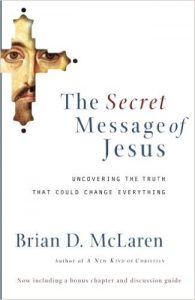 In many ways, all of my previous books are a preparation for this one. It is aimed at a broad audience - including "spiritual but not religious" seekers, members of nonChristian religions, and Christian leaders and thoughtful Christians. It is an exploration of the real "passion of Christ," which is the message of the kingdom of God.
The Secret Message of Jesus hardcover version may be purchased online at: amazon.com, barnes and noble, and christianbook.com. The new softcover version is also available at: amazon.com, barnes and noble, and christianbook.com - it includes a new chapter plus group dialogue questions.
0 Comments6 Minutes